This website is the Republic of Korea government's e-government website

 LOCATION
SAFETY GUIDELINES
-
Shelters near me
-
Surrounding safety facilities
Stage-by-Stage Safety Guidelines
Key Safety Guidelines
- Heavy Rain can cause casualties and property damage through river flooding, landslide, flooding, etc. Therefore, prepare for a heavy rain together with your family and neighbors.
Detailed Safety Guidelines
- Prepare to receive disaster information and check on the disaster risk factors (damage history,e tc.) in your residential area.
- Obtain disaster information from TV, radio, the internet and Emergency Ready App on your smartphone.
- Make an evacuation plan with your family and neighbors.
- Take note of the evacuation points (administrative welfare center, school, etc.) and safe evacuation method in your area, and spread the information to children.
※ For the evacuation route, avoid riverside roads, mountain trails, areas around utility poles and transformers, and inundated areas. - In preparation for a case where your family members move individually, decide a meeting point in advance.
- Take note of the evacuation points (administrative welfare center, school, etc.) and safe evacuation method in your area, and spread the information to children.
- Inspect facilities in your surrounding area.
- Clean drains and rain gutters frequently, and check for areas of rainwater leakage or blockage.
- Inspect slopes, retaining walls, etc. for cracks and, if any structure is in a dangerous state, repair it or report it to the Si/Gun/Gu office.
- Put together an emergency kit and stock up on emergency supplies in preparation for disaster occurrence.
- In preparation for a case where electricity, gas and water supply is stopped, stock up food, water and other supplies to last at least 3 days.
- Prepare emergency supplies, such as first aid kit, flashlights, drinking water, emergency rations, radio, mobile phone charger, portable burner and blankets, at one place.
- If you have a car, fuel it in advance and, if you don’t, make an arrangement to move together with a neighbor who has a car.
Key Safety Guidelines
- When a heavy rain is forecast through the TV, radio and the internet, identify the time of impact on your residential area and take an action together with your family and neighbors to prevent the damage of heavy rain.
Detailed Safety Guidelines
- Refrain from going outside and check the weather conditions as well as disaster and hazard information near your residence as often as necessary.
- If in a danger-prone area, such as mountains, valleys, rivers and breakwaters, move to a safe place together with people around you.
- Stop hiking, camping, swimming, fishing, etc. and move to a safe place immediately.
- If you are in a lowland, an flooding-prone area, a landslide pride-area, an underground space or an old building with a risk of collapse, move to a safe place.
- Protect vehicles and facilities.
- (Home) Check in advance the gutters and drains around your house and unclog them if necessary.
- (Underground Spaces Including Parking Lot) In the underground parking lots of apartment housing and other buildings where flooding is expected, prevent damage by installing water barriers, sand bags, etc.
- (Rivers, Beaches, Lowlands) Move parked cars to a safe place. ※ When the local authorities recommend or order evacuation, vehicles parked at the waterfront should be moved. To receive evacuation information, leave contact information in the vehicle.
- (Rural Villages) Repair irrigation channels, drains and levees to prevent damage and adjust irrigation gates. ※ The actions should be taken before it starts to rain (preliminary alert).
- (Fishing Villages) Securely tie up ships or move them onshore, and move fishing nets and gear to a safe place.
- Prepare for disaster occurrence by stocking up emergency supplies together with your family.
- Prepare an backpack with emergency supplies in advance so that you can evacuate swiftly in case of an emergency.
- As water supply can be cut off, fill the bathtub, etc. with water in advance.
- Check on safety of the vulnerable, such as the elderly, children and the disabled, as often as necessary and spread the emergency evacuation method in advance.
Key Safety Guidelines
- When a heavy rain has started, evacuate to a safe place swiftly. Refrain from going out and contact your family and neighbors to check on their safety.
Detailed Safety Guidelines
- Refrain from going outside and check the weather conditions as well as disaster and hazard information near your residence as often as necessary.
- Check on safety of your family, friends and neighbors who are outside and share hazard information with them.
- Vehicles should be driven with the speed reduced. Do not approach danger-prone areas, such as by a stream or river and near the coast, or flooding-prone areas, and spread the information to people around you.
- Always stay away from danger-prone areas.
- Human and vehicle traffic should be strictly prohibited on flooded roads, underpasses and bridges. Spread the information to people around you so that they do not enter them.
- Quickly leave the areas where you can be swept away in rapids, such as mountains, valleys, around the rivers and coastal areas.
- Do not approach danger-prone areas, such as construction sites, areas near street lights, traffic signals and utility poles, and underground spaces.
- (Rural Villages) Do not go outside to check on levees or irritation gates.
- (Mobile Houses and Temporary Structures) If living in a mobile house or a temporary structure, move immediately to a strong building and inform danger-prone areas to people around you.
- (Landslide-prone Areas) If in a landslide-prone area, evacuate after checking on the signs of a landslide even if a landslide warning is not issued.
- When inside a building or at home, observe the safety rules.
-
- Cut off gas to prevent the secondary damage resulting from gas leakage, and do not touch electrical facilities inside and outside your home to prevent the risk of electric shock.
※ Do not touch electrical facilities with wet hands. - When a blackout occurs, use a flashlight or your mobile phone, not candles.
- When water starts to flow into the building where you are in, move immediately to an elevated place or an evacuation point nearby.
- Cut off gas to prevent the secondary damage resulting from gas leakage, and do not touch electrical facilities inside and outside your home to prevent the risk of electric shock.
- If evacuation is needed due to flooding, risk of collapse, risk of landslide, evacuate together with the vulnerable people around you (the elderly, children, the disabled, etc.).
Key Safety Guidelines
- After a heavy rain, check for damages of your neighbors, and report the damages to a nearby administrative welfare center, etc. for repair and reinforcement.
Detailed Safety Guidelines
- Check on safety of your family and friends, and stay away from areas affected by typhoon.
- Contact your family and friends to check on their safety. If you cannot get in contact with anyone, and the person is suspected to have gone missing, report it to a nearby police station.
- Do not cross flooded roads and bridges because the roads and bridges may have been damaged.
- Stay away from areas near embankments and slopes with the foundation weakened to avoid the risk of collapse.
- If isolated, do not attempt to cross the water. Call 119 or an administrative welfare center (community center), or ask for help to people around you.
- After returning home, check for and report any damages found in your home.
- Returning home after evacuation, make sure to check for safety of the house before entering it.
- Report damaged facilities and structures (housing, water supply and sewage system, retaining walls, roads, etc.) to a nearby administrative welfare center (community service center) or Si/Gun/Gu office.
- When repairing or restoring private facilities that have been damaged, make sure to take photos.
- Prevent secondary damage of heavy rain together with people around you.
- While water is draining out, stay away from it because the water may be contaminated with oil or animal carcasses.
- Use tap water or stored drinking water after sufficiently checking it for contamination. Also, do not consume food or food ingredients that have been submerged in water to avoid the risk of food poisoning.
- In a flooded house, check whether the gas and electrical circuit breakers have been turned off, To resume using gas and electricity, make sure to receive a safety check by an expert or through the Korea Gas Safety Corporation (1544-4500) and the Korea Electrical Safety Corporation (1588-7500) beforehand.
- The houses damaged by a heavy rain are subject to the risk of gas leakage. Therefore, ventilate the indoor air sufficiently by opening windows. Also, do not use matches or a lighter until ventilation is finished.
- Straighten up the fallen crops and, when draining flooded paddy fields and farmlands, wash off soil, filth, etc. from the crops and administer an emergency pest control.
Heavy Rain
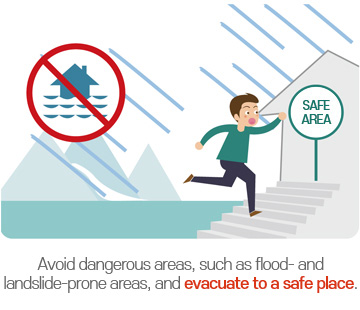
- Avoid dangerous areas, such as flood and landslide-prone areas, and evacuate to a safe place.
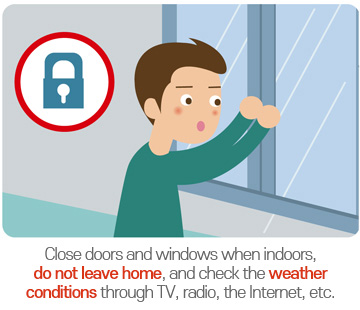
- When indoors, close doors and windows, remain inside, and monitor weather updates through TV, radio, the internet, or other media.
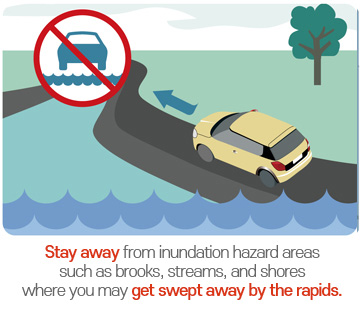
- Stay away from flooding hazard areas such as streams, riverbanks, and coastal areas where you could be swept away by fast-moving water.
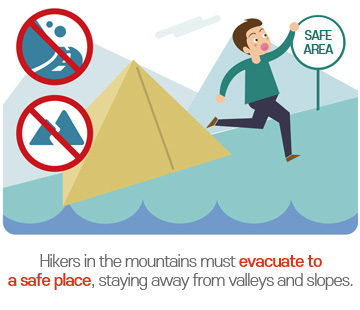
- Hikers in the mountains should evacuate to a safe place, staying away from valleys and slopes.
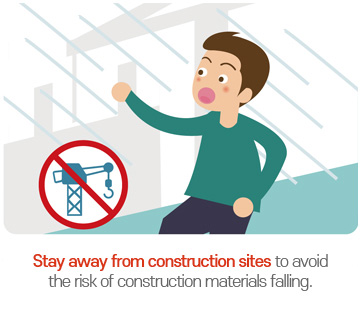
- Stay away from construction sites to avoid the risk of construction materials falling.
- In rural areas, do not go out to inspect rice paddy embankments or irrigation channels.
River Rapids
- Do not approach areas around the rivers when water levels rise due to heavy rain, typhoon, etc.
Vehicle Flooding
- Never attempt to cross underpasses and roads that are flooded even by a little.
Objects Falling in Strong Winds
- Evacuate to an open field or inside a building as much as possible because, in areas near glass windows and signboards, there is a risk of damage caused by objects falling during strong winds.
Lightning
- If you hear a thunder within 30 seconds after a lightning, evacuate swiftly to a safe place. Lower your body immediately and escape to inside a cave or a hollow where there is no water.
Crossing of Overflow Bridge and Other Bridges
- You should not cross overflow bridges or other small-scale bridges when flooded.
Irrigation Gate
- Do not go out to check on irritation gates when a heavy rain or typhoon alert is issued.
Children
- When moving, stay close to parents or teachers and listen to them attentively.
- Move to a safe place in an orderly manner, staying away from strong wind or rain by following instructions of parents and teachers.
※ Safety Guidelines for Guardians - Keep checking that children stay with you to not get lost while moving.
- Do not panic in a disaster situation and guide children to a safe place calmly.
The Elderly and the Disabled
- Do not go outside when a heavy rain or typhoon alert is issued.
- If you have to go outside, inform your children, relatives and neighbors to prepare for unforeseen situations.
※ Safety Guidelines for Guardians - When a heavy rain or typhoon alert is issued, call the elderly and the disabled, such as your parents, to stay inside.
- Maintain a communication channel with the elderly and the disabled, such as your parents, and, when you lose touch with them, report swiftly to a police station, government agency, etc.
Responsible Department
Natural Disaster Response Division (+82-44-205-5233)
